Cette exposition est une invitation à plongerdans son univers pictural, où chaque nuance et chaque geste interrogent la persistance du regard et la profondeur du visible.
___
This exhibition is an invitation to immerse yourself in his pictorial universe, where every nuance and every gesture questions the persistence of the gaze and the depth of the visible.
À travers l’exposition Soft Memories, l’œuvre de l’artiste nigérian Midegbeyan Ojisua se déploie dans l’espace de la galerie comme une archéologie de la mémoire et des formes, où chaque matière semble contenir en elle les strates d’un récit enfoui. Pour sa première exposition monographique en France, l’artiste nous invite à traverser un paysage de textures, de gestes et de fragments, où le temps ne se fige pas mais s’imprime, se superpose et se transforme.
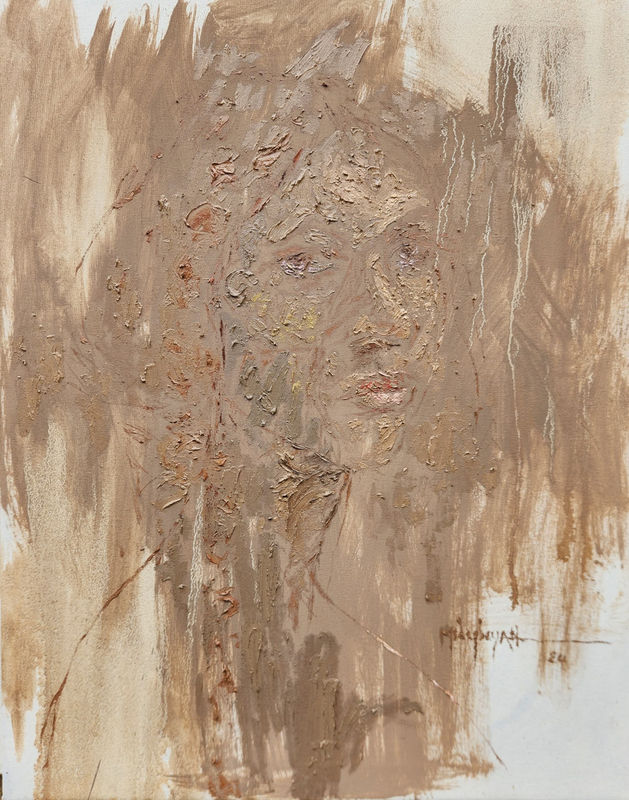
Dans ses œuvres, le portrait n’est jamais figé : il oscille entre apparition et dissolution, entre construction et effacement. Inspiré par les tonalités et la lumière de la Renaissance, Midegbeyan Ojisua compose une palette terreuse et vibrante, où les beiges, ocres et gris se mêlent à des touches incandescentes de rouge ou d’orange. Cet équilibre fragile confère à ses figures une densité organique, comme si elles étaient sculptées directement dans la peinture, prises dans un état de mutation perpétuelle, entreprésence et effacement, comme des réminiscences visuelles en suspens. Dans Girl besides the lamp, l’un des tableaux phares de l’exposition, la présence humaine semble sefondre dans l’environnement, où l’espace domestique – lampe, meuble, ombres diffuses – devientle prolongement du corps. La touche est ample, parfois saccadée, laissant transparaître des traces d’un geste instinctif et presque primitif. Ici, le regard du spectateur oscille entre reconnaissance et abstraction, captant des bribes d’un visage ou d’un corps qui se dérobe.
Dans I miss you, I’m sorry, une femme se tient debout, légèrement tournée vers la gauche, tenant un bouquet de fleurs aux teintes rouges et jaunes. Sa silhouette semble émerger d’un fond aux tonalités terreuses et beiges, où des éléments architecturaux et un paysage lointain apparaissent en filigrane. L’ensemble est texturé, donnant une sensation d’érosion du temps. L’artiste joue sur la transparenceet la superposition de couches pour créer une image presque spectrale, où la figure humaine se fond dans son environnement.
Quant à Where we gonna go from here, une femme est assise dans un intérieur feutré, près d’une fenêtre encadrée de rideaux. Une lampe éclaire doucement la scène, projetant une lumière chaude quicontraste avec les teintes froides du reste de la composition. Les tons violacés, gris et beige se mêlent dans un flou vaporeux, renforçant l’idée d’une scène qui oscille entre le tangible et l’évanescent. Les objets – une table, un vase fleuri – émergent doucement du brouillard pictural, tout comme la silhouette de la femme, dont les traits sont à peine définis.
Dans la plupart de ces portraits, la figuration se précise sans jamais se cristalliser. Un visage émerge d’une matière dense et épaisse, comme exhumé d’un palimpseste de couleurs et de textures. Les touches de lumière creusent l’expression, tandis que des éclats orangés viennent troubler la surface, évoquant une persistance rétinienne, un souvenir capturé avant qu’il ne s’efface. Cette tension entre figuration et disparition est au cœur du travail de Midegbeyan Ojisua, qui fait de la peinture un espace de mémoire et de résonance.
Après une résidence à Lafourchette de Roze, à Bassam, en Côte d’Ivoire, l’artiste a vu ses œuvresrejoindre des collections privées à travers le monde. Cette exposition est une invitation à plongerdans son univers pictural, où chaque nuance et chaque geste interrogent la persistance du regard et la profondeur du visible.
___
Through the exhibition Soft Memories, the work of Nigerian artist Midegbeyan Ojisua unfolds in the gallery space like an archaeology of memory and forms, where each material seems to contain within it the layers of a buried narrative. For his first solo exhibition in France, the artist invites us to traverse a landscape of textures, gestures, and fragments, where time does not stand still but is imprinted, superimposed, and transformed.
In his works, the portrait is never fixed: it oscillates between appearance and dissolution, between construction and erasure. Inspired by the tones and light of the Renaissance, Midegbeyan Ojisua composes an earthy and vibrant palette, where beiges, ochres, and grays mingle with incandescent touches of red or orange. This fragile balance gives his figures an organic density, as if they were sculpted directly into the paint, caught in a state of perpetual mutation, presence and erasure, like visual reminiscences suspended in time. In Girl besides the lamp, one of the exhibition's key paintings, the human presence seems to blend into the environment, where the domestic space—lamp, furniture, diffuse shadows—becomes an extension of the body. The brushwork is broad, sometimes jerky, revealing traces of an instinctive, almost primitive gesture. Here, the viewer's gaze oscillates between recognition and abstraction, capturing fragments of a face or body that eludes us.
In I miss you, I’m sorry, a woman stands slightly turned to the left, holding a bouquet of red and yellow flowers. Her silhouette seems to emerge from an earthy, beige background, where architectural elements and a distant landscape appear in the background. The whole image is textured, giving a sense of the erosion of time. The artist plays with transparency and layering to create an almost spectral image, where the human figure blends into its surroundings.
As for Where we gonna go from here, a woman sits in a cozy interior, near a window framed by curtains. A lamp softly illuminates the scene, casting a warm light that contrasts with the cool tones of the rest of the composition. Purple, gray, and beige tones blend together in a hazy blur, reinforcing the idea of a scene that oscillates between the tangible and the evanescent. Objects—a table, a vase of flowers—gently emerge from the pictorial fog, as does the silhouette of the woman, whose features are barely defined.
In most of these portraits, the figuration becomes clearer without ever crystallizing. A face emerges from dense, thick material, as if exhumed from a palimpsest of colors and textures. Touches of light deepen the expression, while orange flashes disturb the surface, evoking a retinal persistence, a memory captured before it fades away. This tension between figuration and disappearance is at the heart of Midegbeyan Ojisua's work, which makes painting a space for memory and resonance.
After a residency at Lafourchette de Roze in Bassam, Ivory Coast, the artist has seen his works join private collections around the world. This exhibition is an invitation to immerse oneself in his pictorial universe, where every nuance and every gesture questions the persistence of the gaze and the depth of the visible.
