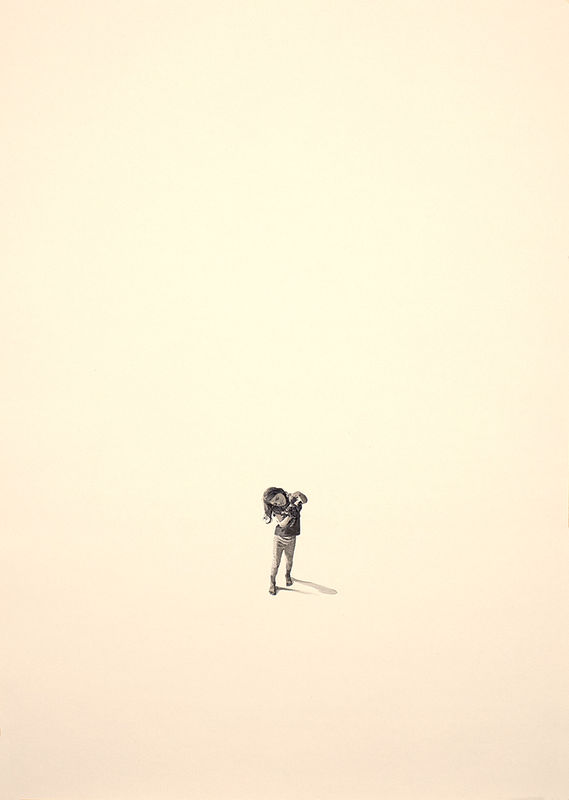
L’exposition invite donc à percevoir notre époque non pas comme un ensemble cohérent, mais comme un kaléidoscope d’expériences, de perceptions […]
___
The exhibition invites us to perceive our era not as a coherent whole, but as a kaleidoscope of experiences and perceptions […]
« Aucun penseur ou artiste d’avant-garde n’échappe à ce reproche (de froideur). Parcequ’il prend terriblement au sérieux l’utopie et sa réalisation, il n’est pas un utopiste, mais il regarde la réalité en face, telle qu’elle est, pour ne pas se laisser abêtir par elle. Il veut libérer de leur emprisonnement les éléments du mieux qui sont contenus en elle. S’il se fait aussi dur que les conditions de vie pétrifées, ce n’est que pour les briser. »
Cette citation du philosophe allemand Theodor Adorno (1903-1969) tente d’expliquer le prisme radical par lequel l’artiste perçoit la réalité. En période trouble, sombre ou inquiétante, l’artiste adresse directement, crûment et sans retenue les problématiques du réel afin d’opérer un véritable tri et d’en extirper les contours de l’espoir.
La complexité inouïe dans laquelle le monde contemporain est plongé - son incohérence, ses drames croissants - implique un éclatement, une fragmentation du réel : il est impossible de rationaliser son tout. L’exposition collective explore cet état de fait en dévoilant morceaux, lambeaux, visions partielles, déplacements de paradigmes, et tentatives de sauvetage.
La peinture de la jeune artiste coréenne Ji-Soo Jung amorce le parcours. Éclatante de couleurs, elle célèbre la force vitale du corps et de ses organes qui, même éclatés, se recomposent sans cesse, dans une extraordinaire énergie échappant à la temporalité. Une forme organique, celle de la sculpture de Zoé Thonet s’en détache, ses courbures lisses et soyeuses évoquent la force intérieure. On découvre ensuite un pied, étrange, qui s’affirme dans sa répétition. Ici, Roxane Gouguenheim montre la plante d’un pied à l’anatomie mythologique. Là, elle sculpte l’argile blanche surmontée de laine ou de bois. Fragments tronqués mais aussi embryons, ils sont à la fois témoins, restes et constructions imaginaires.
Où conserver la mémoire de corps en mutation, où continuer à les dire au-delà de leur enveloppe organique ? Lélia Demoisy nous invite alors à regarder à travers les yeux de l’arbre. Là, se dessine un morceau de la vie d’une forêt gabonaise, que le grand père de l’artiste a pris en photo. Télescopage et superposition. Aussi chez Fabien Merelle, lanature, berceau continuel des réalités multiples et transgénérationnelles, s’offre-t-elle en support. L’artiste dessine sur un morceau de pierre de tuffaut une capsule temporelle de son histoire familiale.
La nature comme écrin des témoignages est aussi le symbole de la régénération. Dans sa peinture sur alcantara, Stephen Whittaker rend hommage au berger Elzéard Bouferqui, entre 1913 et 1947, parvient à recréer une forêt dans une région menacée de désertifcation, tandis qu’Antonin Heck façonne une chouette constituée de matériauxde récupération puis moulée en bronze.
Cet espoir de reconstruction ou de régénérescence se lit dans la peinture de Benjamin Valode où l’horizon se dessine, seul dans l’immensité, comme une lumière miraculée. L’homme à la fenêtre d’Adrien Belgrand la contemple peut-être, confant son regard au lointain. Plus sombrement dans la grande toile d’Aurélie Bauer, intitulée Renaissance, cohabitent, au cœur d’un naufrage, des identités multiples en recherche d’un avenircommun. Les destins individuels se confondent et coexistent.
La question de la trace se pose alors avec l’œuvre de Mamali Shafahi & Domenico Gutknecht qui crée un subtil écrin d’epoxy chantant le souvenir d’un être cher. Dans l’absence du portrait attendu et l’entremêlement des fils détissés, le travail de Golnaz Payani extrait des bribes d’existence d’où subsiste une écriture aux signifiants évidés. Chez Coskun, un maigre contour rouge souligne l’abstraction d’un corps qui repose surdes morceaux de bois épars et prisonniers.
Alors, après avoir tout effacé, l’utopie dont parlait Adorno surgit parfois. La peinture de Zélie Nguyen attribue à l’animal l’immense tâche de la reconstruction. Dans la contemplation d’un feu qui laisse la nature intacte, il hésite à pénétrer dans l’espace, peut-être est-il trompeur ? Sur la balance d’Abdelhak Benallou, le livre est plus lourd que le smart phone. L’imaginaire l’emporte sur la réalité.
L’exposition invite donc à percevoir notre époque non pas comme un ensemble cohérent, mais comme un kaléidoscope d’expériences, de perceptions, d’instants disparates, ballotés entre existence, disparation et résurgence
Lara Sedbon
___
«No avant-garde thinker or artist escapes this criticism (of coldness). Because he takes utopia and its realization terribly seriously, he is not a utopian, but he looks reality in the face, as it is, so as not to be dulled by it. He wants to free the elements of goodness contained within it from their imprisonment. If he makes himself as hard as the petrified conditions of life, it is only to break them. "
This quote from German philosopher Theodor Adorno (1903-1969) attempts to explain the radical prism through which the artist perceives reality. In troubled, dark, or disturbing times, the artist addresses the issues of reality directly, bluntly, and without restraint in order to sort through them and extract the contours of hope.
The unprecedented complexity in which the contemporary world is immersed—its inconsistency, its growing dramas—implies a shattering, a fragmentation of reality: it is impossible to rationalize it as a whole. The group exhibition explores this state of affairs by revealing pieces, shreds, partial visions, paradigm shifts, and attempts at rescue.
The painting by young Korean artist Ji-Soo Jung kicks off the journey. Bursting with color, it celebrates the vital force of the body and its organs, which, even when shattered, constantly rebuild themselves with extraordinary energy that transcends time. An organic form emerges from Zoé Thonet's sculpture, its smooth, silky curves evoking inner strength. Next, we discover a strange foot, which asserts itself through repetition. Here, Roxane Gouguenheim shows the sole of a foot with a mythological anatomy. There, she sculpts white clay topped with wool or wood. Truncated fragments but also embryos, they are at once witnesses, remains, and imaginary constructions.
Where can we preserve the memory of changing bodies, where can we continue to express them beyond their organic envelope? Lélia Demoisy invites us to look through the eyes of the tree. Here, a piece of the life of a Gabonese forest, photographed by the artist's grandfather, takes shape. Collision and superimposition. For Fabien Merelle, too, nature, the continual cradle of multiple and transgenerational realities, offers itself as a medium. The artist draws a time capsule of his family history on a piece of tuff stone.
Nature, as a backdrop for testimonies, is also a symbol of regeneration. In his painting on Alcantara, Stephen Whittaker pays tribute to the shepherd Elzéard Bouferqui, who between 1913 and 1947 managed to recreate a forest in a region threatened by desertification, while Antonin Heck crafts an owl made from recycled materials and then cast in bronze.
This hope for reconstruction or regeneration can be seen in Benjamin Valode's painting, where the horizon stands out, alone in the immensity, like a miraculous light. The man at the window by Adrien Belgrand perhaps contemplates it, gazing into the distance. More sombrely, in Aurélie Bauer's large canvas entitled Renaissance, multiple identities coexist in the midst of a shipwreck, searching for a common future. Individual destinies merge and coexist.
The question of traces arises in the work of Mamali Shafahi & Domenico Gutknecht, who create a subtle epoxy setting that sings the memory of a loved one. In the absence of the expected portrait and the intertwining of unraveled threads, Golnaz Payani's work extracts fragments of existence from which a writing with hollowed-out signifiers remains. In Coskun's work, a thin red outline emphasizes the abstraction of a body resting on scattered pieces of wood.
So, after erasing everything, the utopia Adorno spoke of sometimes emerges. Zélie Nguyen's painting assigns the animal the immense task of reconstruction. Contemplating a fire that leaves nature intact, it hesitates to enter the space. Perhaps it is misleading? On Abdelhak Benallou's scales, the book is heavier than the smartphone. Imagination prevails over reality.
The exhibition therefore invites us to perceive our era not as a coherent whole, but as a kaleidoscope of experiences, perceptions, and disparate moments, tossed between existence, disappearance, and resurgence.
Lara Sedbon


